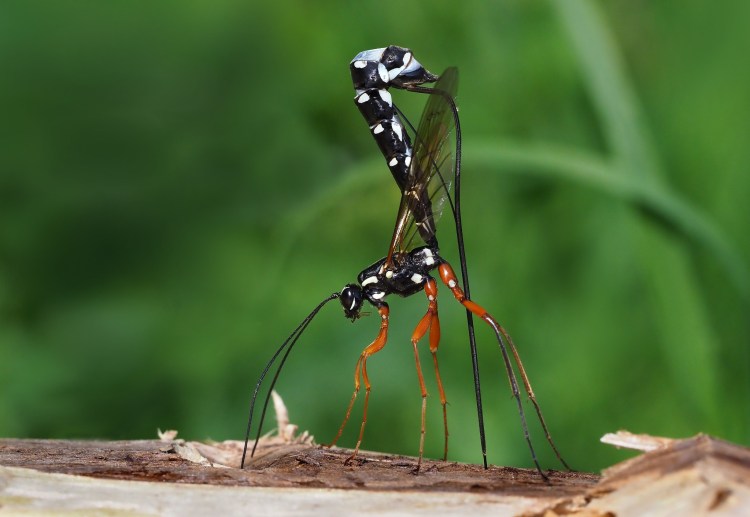
‘Giant Ichneumon Wasp’ photo by Frank Vassen CC BY 2.0.
The Giant Ichneumon Wasp (See photo above), also called, ‘The Stump Stabber’ is as one website proclaimed, ‘A MOST SPECTACULAR WASP!’ One of the ‘wonders’ God has preformed that ‘cannot be fathomed!’ Quoted from Job 5:9.
‘The whole earth is filled with awe at your wonders; where morning dawns, where evening fades, you call forth songs of joy.’ Psalm 65:8. I couldn’t help but write about this ‘Uncommonly strange, complex and interesting wasp.’
It reminds me of the scripture from Ephesians, ‘Now to him who is able to do immeasurably more than all we ask or imagine, according to his power that is at work within us.’ Ephesians 3:20. I have written 239 posts about critters and the message they contain, but this one beats them all! I would say that it is a metaphor once again of God’s provision. What this ‘Stump Stabber’ can do to survive is extraordinary and as the scripture above says, fills me with awe.
It is called a ‘giant’ for a reason. The female wasp is only 2 inches long but has an ovipositor that is 3 to 4 inches long, the largest of any insect in the world. That makes its overall length 5 to 6 inches! Its ovipositor is the female’s egg laying organ used to deposit eggs in the wood of dead or dying trees. First you see this wasp tapping the surface of the bark with its antennae (antennating), searching the bark of a tree, seemingly determined to find something. What it is looking for, ‘divining’, as some say, is the grub of a female wood-boring Horntail Wasp. This wasp drills a hole in the bark of the tree and deposits its egg along with wood-digesting fungi that helps its grubs extract food value while feeding on the wood. As this grub matures, it digs a 10-to-12-inch tunnel deep inside the tree. The ‘stump stabber’ can determine the exact location of these horntail grubs within the tree! Some botanists say they do this using radar (doubt it), others say they smell the fungi deposited by the female horntail wasp. How they find this exact location still remains a mystery!
Once the grub of the Horntail is located, the Stump Stabber positions herself with her back legs extended and her ovipositor perpendicular to the bark. (See photo). She uses her ovipositor to ‘drill’ a hole into the tree to deposit her egg on or near the horntail grub. At the same time, she paralyzes the grub with a ‘sting’ from her ovipositor. She can ‘drill’ up to the length of her ovipositor! According to Wikipedia, the exact movements of the ovipositor during the ‘drilling’ is unclear. *
When her egg hatches, it feeds on the paralyzed horntail grub, pupates within the tunnel and emerges in the summer.
You can watch this wasp in action on YouTube by clicking on the following link:
‘Wasp Deposits Parasitic Larvae Deep Inside Tree Trunk’
*I discovered a website entitled: ‘The Engineer Webinar’.
It posted an article entitled, ‘Surgical Tool Inspired by Ovipositor of Parasitic Wasp.’
Apparently, researchers at Delft University of Technology in the Netherlands have developed a new surgery device that may allow researchers to surpass the boundaries faced by current surgical tools based on the very ovipositor we have been talking about! The following is a paragraph from their article. They apparently are beginning to figure out how in the world the ovipositor of this, ‘Most Spectacular Wasp’ works!!
They are quoted as saying: ‘The ovipositor is an ultra-thin organ, shaped like a flexible hollow needle, used by parasitic wasps to lay their eggs in trees or live hosts. Inside this delicate organ is a series of blades that join with a tongue-and-groove mechanism. The blades can slide independently of each other to create friction forces by using their mechanical movement, and these friction forces were used by the researchers in the implementation of their design of their new surgical tool!’ It offers promising potential for treating diseases currently not treatable and reachable with existing equipment. This is another example of BIOMIMICRY, ‘the design and production of materials, structures, and systems that are modeled on biological entities and processes.’
New Oxford American Dictionary.
If you want to read more, click on the following link:
https://www.theengineer.co.uk/content/news/surgical-tool-inspired-by-ovipositor-of-parasitic-wasps
‘OUR GOD IS AN AWESOME GOD’


wow! How amazing is our God and all His creative wonders. Surely His creation can teach us! Thanks for this astounding post!
kb
LikeLike
that’s amazing! Thanks for sharing the wonders of Gods creation. And think about all the possibilities a surgical tool like that could accomplish.
-SP
LikeLike