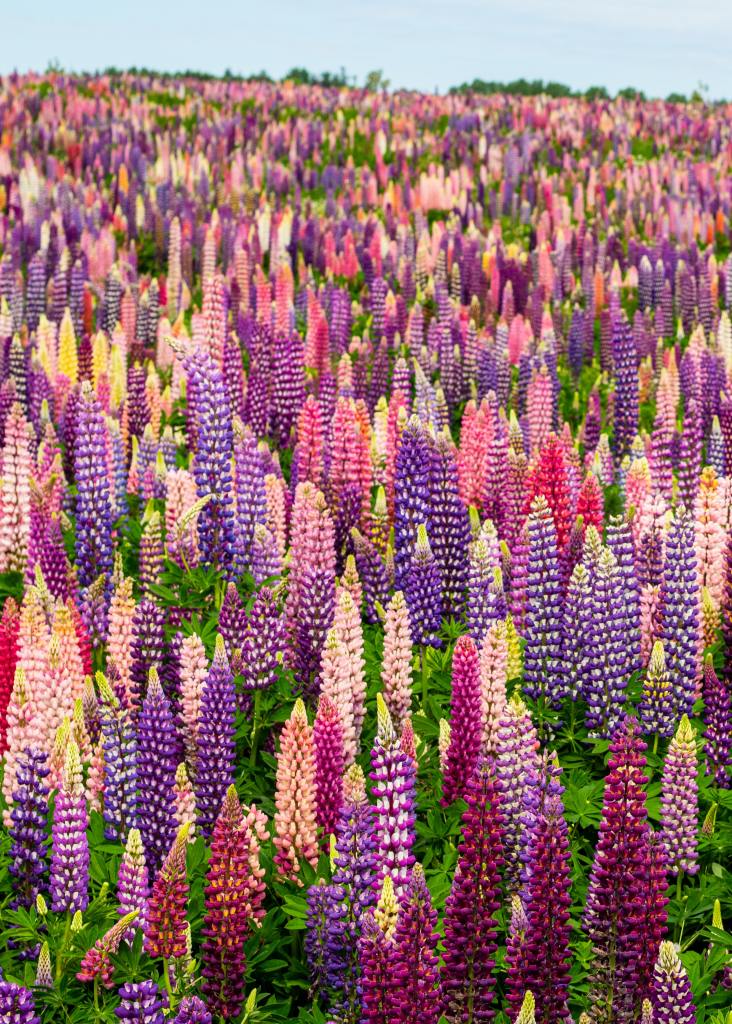
Lupine Flowers by Andreas Christiansen on Unsplash.
Thinking about Spring? Read on!!!!!
Nitrogen really gets around! It makes its appearance as a blue or purplish red color in the Aurora Borealis when charged particles from the solar wind collide with it in the earth’s atmosphere. It lights a fire under me when I hear the word NITRO short for nitromethane, a fuel used by TOP FUEL dragsters which is a combination of nitrogen, carbon and oxygen. It makes me remember being at the dragstrip and seeing a ‘nitro’ burning, Top Fuel dragster go over 300 mph in a quarter of a mile!!! Nitro or nitromethane fuel can triple a four-stroke engine’s horsepower. These dragsters have some 6000 horsepower thanks to nitrogen.
It is also in our atmosphere and in our soil. It is nitrogen that is responsible for our lush green plants! It acts as a fertilizer for soil. There is plenty of it in our atmosphere, but most plants have no way to absorb it. However, there is a wonderful plant called the lupine (see photo above) that does us all a gigantic favor by converting nitrogen from the atmosphere into a form that plants CAN absorb. This ability to convert nitrogen allows lupine plants to grow in infertile, barren, or poor-quality soils which it proceeds to greatly improve! Farmers and gardeners use these plants as a cover crop in the off-season to replace the nitrogen in the soil consumed by harvested crops.
The Lupine is another astounding metaphor in this metaphoric world where everything God created is a metaphor, representative or symbolic of something else! In this case, clearly showing us how we should live!!
Jesus said, ‘Love the Lord your God with all your heart and with all your soul and with all your mind. This is the first and greatest commandment. And the second is like it: ‘Love your neighbor as yourself.’ Matthew 22:38-39.
Here is the Lupine, ‘loving’ enough to grab the nitrogen out of the air and put in the soil which benefits itself (‘love yourself’) and is beneficial to others around it and future generations of plants that will grow in this soil. (‘love your neighbor’).
In other words, ‘bloom where you are planted’. Pay it forward’. Give back, just like the Lupine, loving your neighbor fulfilling Jesus’ commandment to ‘love your neighbor as yourself’, making the world a better place.
It is interesting to note that in Judaism, they have a tradition they call ‘tikkun olam’. It is based on Leviticus 19:33-34 found in the Torah. It reads: ‘When a foreigner resides among you in your land, do not mistreat them. The foreigner residing among you must be treated as your native-born. Love them as yourself, for you were foreigners in Egypt. I am the Lord your God.’ Leviticus 19:33-34.
They believe that they share a partnership with God to improve the state of the world by helping others which in turn brings honor to God!
How can we make the world a better place?
For a Christian, our number one thing we can do to ‘Make the world a better place’ is to OBEY the first and second commandments found in Matthew 22:38-39.
‘Love the Lord your God with all your heart and with all your soul and with all your mind and Love your neighbor as yourself.’
Take the time to learn to hear God’s voice and do what HE tells you to do!
Ask the Holy Spirit to help you develop His ‘gifts of the Spirit’ in YOU! Love, joy, peace, longsuffering, patience, kindness, goodness, faithfulness, gentleness and self-control. Galatians 5:22-23.
Everyone has a gift or two! Use your gift(s), develop them, to make the world a better place. I remember reading ‘Celebrate Yourself’. The author said, “Hey, if you play an instrument and don’t have the opportunity to play in the symphony orchestra, then play for your family and friends!” Good word.
There are also umpteen sights listed on the internet (even Opra.com) under ‘How can I make the world a better place’ that you can read.
They suggest things like, getting to know your neighbors.
Complimenting friends and strangers.
Paying it forward.
Supporting a worthy cause.
Volunteering your time.
Donating blood.
Being positive.
Getting your head out of your cell phone. (mine).
Etc., etc. Good things we can all do!
We were in the drive-through line at Starbucks in Colorado Springs and someone in front of us paid for our drinks. Apparently, the record for ‘paying it forward’ at Starbucks is 23 cars!!! I thought that was wonderful!
And, ‘Let us not become weary in doing good, for at the proper time we will reap a harvest if we do not give up. Therefore, as we have opportunity, let us do good to all people, especially to those who belong to the family of believers. Galatians 6:9-10.
BE A LUPINE!


Thanks for the insight(s) Stu!
I was told Alder trees put nitrogen back in the soil as well when their leaves drop & decompose.
I have a love/hate relationship with Alder trees.
They grow like weeds here in Southeast Alaska & sprout up anywhere – Even on rock! In the Spring I’m constantly pulling up their shoots where I don’t want them to be.
On the other hand, I am regularly harvesting Alder trees to replenish our firewood supply. After seasoning it for six months in the woodshed it is used as fuel to heat our house.
LikeLike
Yes! May we all become lupine and nourish those around us!
LikeLike
Love God, love people! Also, beautiful picture!
LikeLike
Fantastic!
LikeLike
There are many ways to help people. Look to God to show you the way.
LikeLike