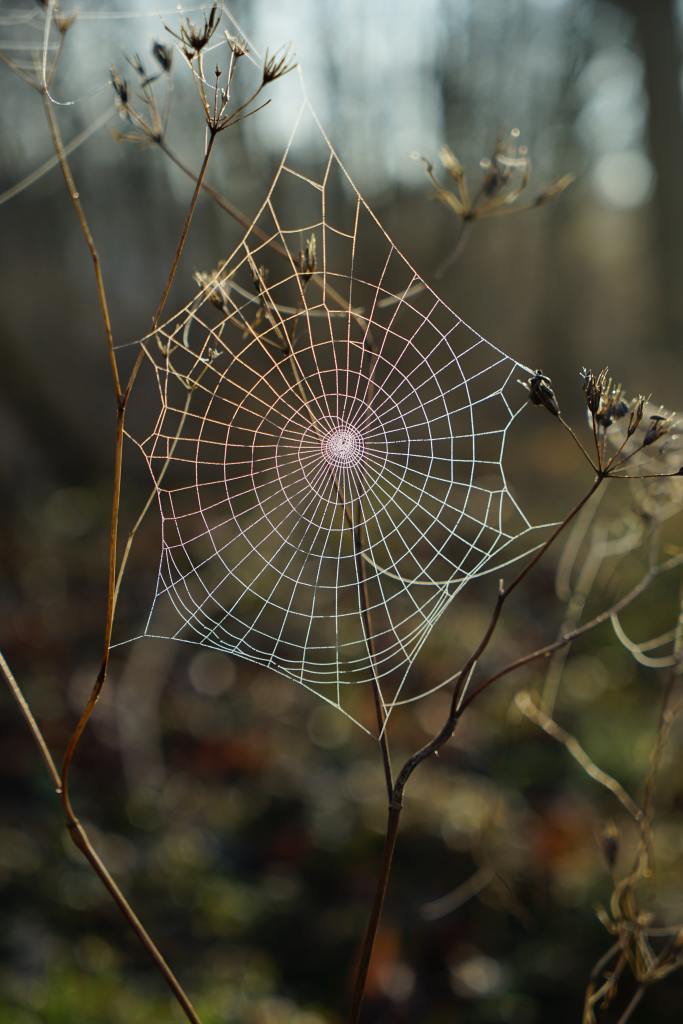
Orb Spider photo by Robert Anasch on Unsplash
What do you think about when you see a spiderweb?
Do you see a geometric wonder like King David who wrote, ‘many, Lord my God are the wonders you have done.’ Spiders don’t have a lot of fans, unless you consider Wilbur of ‘Charlotte’s Web’ whose friend Charlotte wrote ‘SOME PIG’ in her web to save Wilber the pig from being turned into bacon.
But they do make a beautiful web, often highlighted by dew or frost (just so you’ll see them).
They are also tiny master engineers! The classic web seen in the photo above was made by an orb weaver spider. They begin their web by stringing ‘bridge lines’ from branch to branch or, in the case of the Darwin spider of Madagascar, more than 80 feet across rivers and lakes!
Then they add radial threads that extend out from the center like the spokes of a bicycle wheel. Another set of threads spiral out from the center in concentric circles. (Do yourself a favor and watch a Spiny Orb Weaver Spider Spinning A Web on YouTube).
(#MyBackyardBirding #spiderweb #orbweaver)
These tiny silk threads they use to create their web are produced by glands in the spider’s abdomen and are super strong. Relative to weight, the strength of a spider web thread rivals steel and Kevlar, the material used to make bullet-proof vests. In fact, this tensile strength has inspired humans to develop a surprising number of products.
Spiders are like tiny silk production factories. Inside their bodies, thread is stored as a highly concentrated liquid protein which transforms to solid thread when it leaves the body. A common garden spider can produce as many as seven types of silk, each made up of a different sequence of proteins. Each type of thread serves a distinct purpose: one, for example, makes the web stretchy to better absorb the impact of insects smacking into it; another makes the thread less brittle. Still other proteins protect the threads from bacteria and fungi and keeps it moist. Spider webs are typically sticky to catch bugs, thank goodness the spider has tiny claws on its legs to help keep it from being stuck to its own web! And just remember, spiders are your friends consuming 880 million tons of insects each year! Live Science.
God, whose name is ‘wonderful’, WONDER FULL (Isaiah 9:6) created the wonder of a spider’s web to woo you to Himself that you might know just how wonderful He truly is!
Who knows? Perhaps Charlotte and her web will ‘save your bacon’ too!!!


how wonderful is our creator who created such splendor! Thank you for reminding us each week about what a wonderful gift our creator has given us in His creation!
kb
LikeLike
This is a nice way to start the week, thinking about somthing beutiful that God has made.
Thank you.
Mandel
LikeLike
Thanks Mandel for being such a faithful reader! I greatly appreciate your comments!!!
Stu
LikeLike